Cans baler

Metal Baler
December 01, 2025
Category Connection: Hydraulic Metal Baler Machine
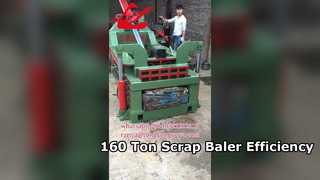
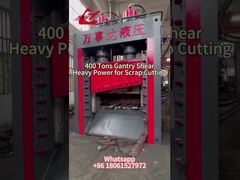
Brief: In this video, we showcase the powerful Y83/T-160 Hydraulic Metal Compactor in action, demonstrating how it transforms loose metal scraps into dense, uniform blocks. You'll see its large feeding chamber handling various scrap types and learn how its PLC semi-automatic control system ensures efficient, safe operation for recycling centers. Stay tuned as we highlight the most important features and real-use results.
Related Product Features:
  • Delivers 1600 kN compression force to create high-density 400x400 mm bales ideal for transport and melting.
  • Features a large 1600x1000x800 mm charging chamber for handling big and irregular metal scraps.
  • Provides high processing capacity of 2000-3000 kg per hour for medium-to-large recycling operations.
  • Utilizes a stable PLC semi-automatic control system for user-friendly and safe operation.
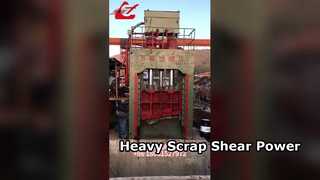
  • Built with a heavy-duty welded steel frame for long service life under continuous operation.
  • Powered by a 22 kW motor that offers strong performance with low energy consumption.
  • Designed with high-quality hydraulic components to reduce maintenance and downtime.
  • Manufactured under ISO9001:2000 standards with strict welding and mechanical inspections.
Faqs:
  • What types of scrap metal can this compactor process?
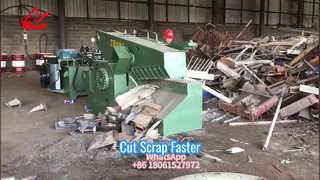
    It is suitable for compressing steel, aluminum, copper, stainless steel, light metals, punching offcuts, and various production waste materials.
  • How large is the feeding chamber and what is the final bale size?
    The charging chamber measures 1600x1000x800 mm, accommodating large scrap pieces, and it produces uniform bales sized 400x400 mm.
  • Is specialized training required to operate this metal baler?
    No, the PLC semi-automatic control system is designed for easy operation, allowing users to master it quickly with minimal training.
  • What is the machine's processing capacity and cycle time?
    It can process 2000-3000 kg per hour with a single cycle time of less than 80 seconds for efficient operation.